
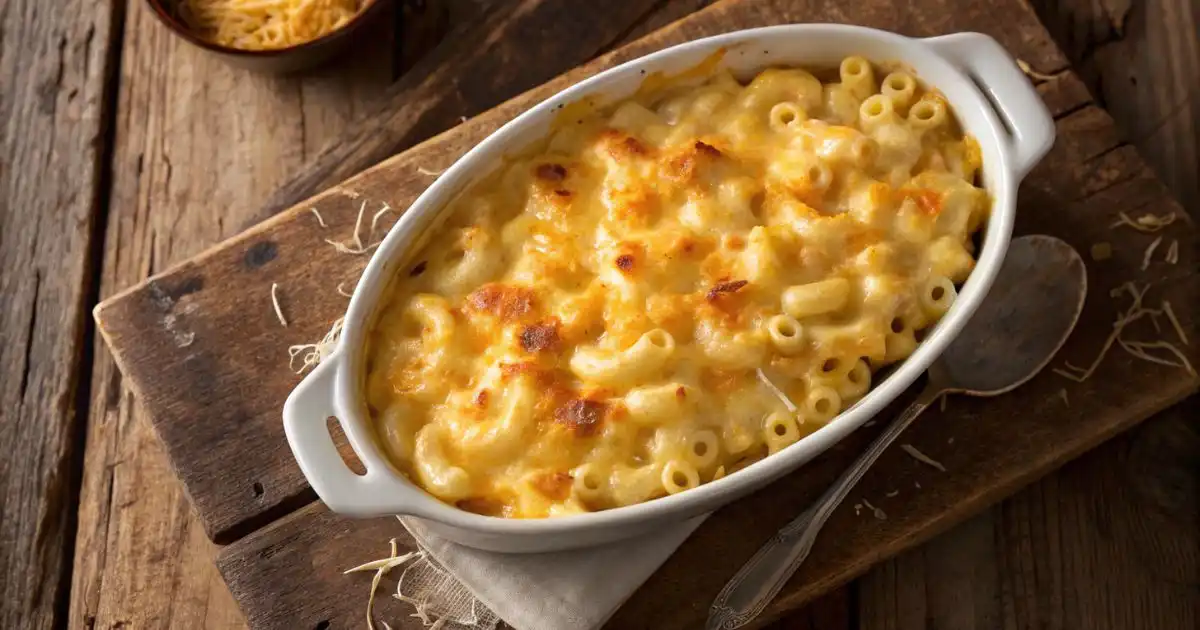
Copycat Cracker Barrel Mac and Cheese Recipe
There is a specific kind of comfort that belongs exclusively to Cracker Barrel. You push open that screen door, weave past the rocking chairs, and eventually settle into a wooden booth with a peg triangle game sitting between you and whoever you came with. You lose the game immediately, you always do, and then a small white bowl arrives. Inside it: a cloud of elbow pasta draped in a sauce that is somehow both deeply savory and warmly sweet, golden-orange and glossy, steaming from what appears to be a very brief encounter with a hot oven.
That bowl is not complicated. But it is specific. And for years, home cooks have tried to reverse-engineer it with nothing more than a box of dried pasta and a bag of pre-shredded cheddar, only to end up with something that tastes fine, but never quite right.
This ultimate guide to the Cracker Barrel mac and cheese recipe exists to fix that. After extensive testing, we have identified the two non-negotiable restaurant secrets that separate their version from every generic stovetop attempt. This is the most comprehensive copycat Cracker Barrel macaroni guide on the internet, consolidating years of recipe testing into one authoritative, step-by-step resource. Whether you are chasing nostalgia, feeding a crowd, or simply trying to understand why Colby cheese mac and cheese hits differently than anything else you have made, you are in the right place.
Table of Contents
The 2 Restaurant Secrets to the Perfect Copycat
You can follow a hundred different mac and cheese recipes and never once land on that specific Cracker Barrel flavor. That is not a failure of technique; it is a failure of ingredients. Two specific choices define this dish above all others.
Secret 1: The Cheese: Why Colby Is Non-Negotiable
Walk into any grocery store, and you will find approximately fourteen varieties of pre-shredded cheddar. Sharp, extra-sharp, mild, white, yellow, blended. None of them is what you need for an authentic Cracker Barrel mac and cheese recipe.
Cracker Barrel’s signature character comes from Colby cheese, a washed-curd American cheese that sits in a category entirely its own. Unlike sharp cheddar, which is aged long enough to develop a pronounced tang and a crystalline, slightly crumbly texture, Colby is younger, moister, and significantly sweeter at its baseline. The fat content is distributed more evenly throughout the paste, which means when you introduce it to a warm béchamel, it surrenders into the sauce without protest, no graininess, no grease pooling at the surface, no sharpness cutting through the creaminess.
The flavor profile of Colby is mild, buttery, and ever-so-slightly sweet, which is precisely the character you recognize in that restaurant bowl. Sharp cheddar, by contrast, brings an acid-forward brightness that, while delicious in its own right, pushes the sauce in a completely different direction. If you want restaurant-style mac and cheese with that round, mellow, nostalgic sweetness, Colby is the only answer.
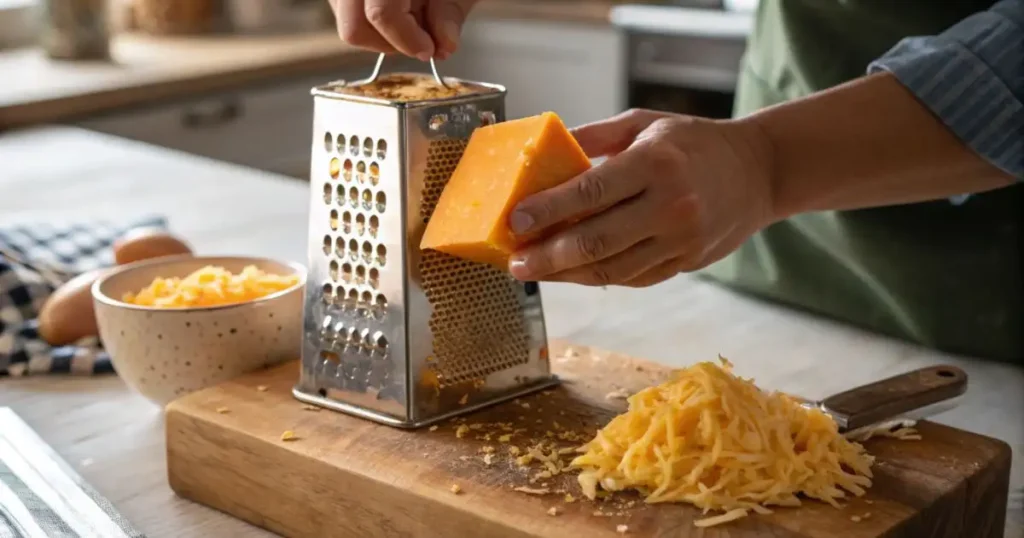
Buy it in a block and grate it yourself. This point will be reinforced throughout this guide because it matters enormously, but more on that in its own dedicated section.
Secret 2: The Broth: The Invisible Flavor Layer
The second secret is quieter. You won’t be able to point to it on the plate, but the moment you taste the finished sauce, your palate will register something that feels inexplicably complete, a savory, almost diner-like depth that a pure milk béchamel simply cannot produce.
That depth comes from chicken broth.
A classic béchamel is built entirely on butter, flour, and whole milk. It is rich, creamy, and neutral, an excellent canvas. But replacing a small portion of the milk with good chicken stock introduces a deeply savory poultry backbone that weaves through the sweetness of the Colby, giving the sauce a complexity that makes you feel like you are eating something that has been simmered all afternoon rather than made in twenty minutes. It is the difference between a sauce that tastes cheesy and a sauce that tastes finished.
Use a low-sodium stock so you control the salt. Full-flavored store-bought broth works excellently here; you are not looking for a dominant chicken flavor, just a subliminal savory lift that the milk alone cannot deliver.
Standard Homemade vs. Cracker Barrel Style
Before you reach for your apron, take one minute to understand exactly where this recipe diverges from the everyday homemade version most people default to. The table below maps the three most critical differences.
| Feature | Standard Homemade | Cracker Barrel Copycat |
| Cheese Type | Sharp cheddar or a generic blend | Block Colby, freshly grated — sweeter, creamier melt |
| Liquid Base | Whole milk only | Whole milk + chicken broth for savory depth |
| Baking Style | Often skipped, or baked until firm with a breadcrumb crust | Brief oven finish — just long enough to bubble the edges without drying the interior |
The differences look small on paper. In the bowl, they are everything.
The Grocery List (Ingredients)
Serves 6 as a side dish. Scale freely.
The Pasta
- 8 oz (225g) elbow macaroni, standard supermarket elbows work perfectly; no need for artisan pasta here
The Roux Base
- 3 tablespoons unsalted butter
- 3 tablespoons all-purpose flour
The Liquid Foundation
- 1½ cups whole milk, not reduced fat; the fat content is structurally important
- ½ cup low-sodium chicken broth or stock, the savory secret weapon
The Star
- 2½ cups freshly grated block Colby cheese, see the dedicated section below before purchasing; this ingredient decision makes or breaks the dish
The Seasoning
- ½ teaspoon garlic powder
- ½ teaspoon onion powder
- ¾ teaspoon fine sea salt, adjust at the end once the broth’s saltiness is accounted for
- ¼ teaspoon freshly cracked black pepper
Step-by-Step Cooking Instructions
Step 1: The Pasta Boil: Cook Pasta Al Dente on Purpose
Bring a large pot of aggressively salted water to a rolling boil. Slide in the elbow macaroni and cook it for one to two minutes longer than the package’s al dente recommendation. You are not aiming for a firm, toothsome bite here; Cracker Barrel’s noodles are soft, yielding, and tender. They surrender to the fork rather than resist it. That pillowy, diner-style texture is part of the identity of this dish.
Drain the pasta thoroughly, then toss it with a tiny knob of butter to prevent sticking while you build the sauce. Do not rinse the pasta; the surface starch helps the sauce cling.
Step 2: The Savory Roux: Building the Glossy Foundation
Set a heavy-bottomed saucepan or Dutch oven over medium heat. Once the pan is warm, lay in the unsalted butter and watch it melt and begin to foam. The moment the foam begins to subside, add the rain in the all-purpose flour all at once and begin working it with a sturdy whisk.
Keep the whisk moving. What you are building is a blond roux, and it needs to cook for a full two minutes, long enough that the raw flour taste cooks out and the mixture begins to smell faintly of warm toasted grain. The paste will look pale gold and feel thick under the whisk. That is exactly right.
Now, working slowly and deliberately, stream in the whole milk in three additions, whisking vigorously between each pour to prevent lumps from forming. Once all the milk is incorporated, pour in the chicken broth and continue whisking over medium heat. The sauce will thicken steadily. You are looking for a texture that coats the back of a spoon and holds a clean line when you draw your finger through it, glossy, smooth, and deeply fragrant from the broth.
Season the base now with the garlic powder, onion powder, salt, and black pepper. Taste and adjust — the broth brings its own salinity, so season with care.
Step 3: The Dairy Emulsion: The Most Important Moment in the Recipe
Here is where most copycat recipes fail. They leave the pan on the heat and add the cheese directly into a simmering sauce. The result is a grainy, broken, greasy mess, and the culprit is temperature.
Pull the pan completely off the burner. Let it sit off the heat for sixty seconds. The sauce should be hot enough to melt the cheese but not so violent that it causes the proteins to seize and the fat to split.
Now, working in three loose handfuls, fold the freshly grated block Colby into the hot béchamel. Do not dump it all in at once; give each addition time to dissolve before introducing the next. Use a spatula or wooden spoon in slow, deliberate strokes. Watch as the pale yellow shreds vanish into the sauce, transforming it from a simple white béchamel into a glossy, golden emulsion of extraordinary creaminess.
If the cheese is not fully melting from the residual heat alone, you can return the pan to the lowest possible burner setting for thirty seconds at a time, but do not let it simmer again.
Step 4: The Final Toss and the Brief Bake
Pour the drained elbow macaroni into the cheese sauce and fold gently until every curve of every noodle is enveloped. The sauce will look almost aggressively glossy and wet at this stage; it should. It will tighten slightly in the oven.
Transfer everything into a lightly buttered casserole dish. Here is the critical distinction between this recipe and a standard baked mac and cheese: Cracker Barrel does not bake theirs into a firm, sliceable casserole. The oven is used only to bring the dish to an ideal service temperature and to coax the edges into a very gentle, bubbling, slightly set border, while the interior remains luxuriously saucy and spoonable.
Bake at 375°F (190°C) for 12 to 15 minutes, no longer. You are looking for wisps of steam and small bubbles forming around the perimeter. Pull it the moment you see those signs. Serve immediately, directly from the dish.
Why You Should Never Use Pre-Shredded Cheese
This section exists because the temptation to grab a green bag of shredded Colby from the dairy aisle is real, understandable, and absolutely something you must resist.
Pre-shredded cheese is coated in anti-caking agents, most commonly powdered cellulose (a form of wood pulp fiber) or potato starch. These coatings serve a useful commercial purpose: they prevent the shreds from fusing into a clump in the bag. But they do something catastrophic inside a cheese sauce.
When cellulose-coated shreds hit your warm béchamel, they do not melt; they resist melting. The coating acts as a barrier between the cheese proteins and the surrounding liquid, preventing the smooth emulsification that defines a great sauce. Instead of that velvety, glossy emulsion you are after, you end up with a gritty, slightly grainy sauce with a thin, oily sheen. The texture never fully resolves into smoothness because the coating refuses to disappear into the sauce the way uncoated cheese does.
Buy a block. Grate it yourself. A box grater takes three minutes. Those three minutes are the difference between a good mac and cheese and a transcendent one. For this Colby cheese mac and cheese specifically, where the smooth, creamy melt is the entire point, this shortcut is simply not worth it.
Make-Ahead, Storage, and Reheating Rules
Make-Ahead: The cheese sauce can be prepared up to 24 hours in advance and refrigerated separately from the cooked pasta. Store both in airtight containers. When ready to serve, gently warm the sauce in a saucepan over low heat with a splash of milk, fold in the pasta, then proceed with the brief bake as directed.
Storage: Leftovers keep beautifully in an airtight container in the refrigerator for up to four days.
Reheating, The Right Way: This is not a dish you microwave. The microwave applies uneven heat that causes the emulsion to break, producing an oily, separated sauce with a rubbery pasta texture.
Instead, transfer the leftover mac and cheese to a small saucepan over the lowest possible heat setting. Add a splash of whole milk, roughly two tablespoons per cup of leftovers, and stir slowly and continuously as the dish warms. The milk rehydrates the sauce and coaxes the emulsion back into its original glossy, cohesive state. Within three to four minutes, the mac and cheese will be restored to something remarkably close to its original texture.
If you must use a microwave, transfer to a bowl, add the splash of milk, cover loosely, and microwave at 50% power in 45-second intervals, stirring between each, never at full power.
Copycat Cracker Barrel Mac and Cheese
Ingredients
Pasta
- 8 oz elbow macaroni
Roux Base
- 3 tbsp unsalted butter
- 3 tbsp all-purpose flour
Liquid Foundation
- 1.5 cups whole milk
- 0.5 cup low-sodium chicken broth
Cheese
- 2.5 cups freshly grated Colby cheese grated from a block
Seasoning
- 0.5 tsp garlic powder
- 0.5 tsp onion powder
- 0.75 tsp fine sea salt adjust to taste
- 0.25 tsp black pepper freshly cracked
Instructions
- Bring a large pot of salted water to a boil. Cook the elbow macaroni slightly longer than al dente until tender. Drain and toss with a small amount of butter. Set aside.
- In a saucepan over medium heat, melt the butter. Add the flour and whisk continuously for about 2 minutes to form a smooth blond roux.
- Slowly whisk in the milk in batches, ensuring no lumps form. Add the chicken broth and continue whisking until the sauce thickens and becomes smooth.
- Season the sauce with garlic powder, onion powder, salt, and black pepper. Taste and adjust seasoning as needed.
- Remove the pan from heat and let it cool for about 1 minute. Gradually add the grated Colby cheese in batches, stirring gently until fully melted and smooth.
- Add the cooked pasta to the cheese sauce and mix until fully coated.
- Transfer the mixture to a buttered casserole dish. Bake at 190°C (375°F) for 12–15 minutes until the edges are lightly bubbling but the center remains creamy.
- Serve immediately while hot and creamy.
Notes
Frequently Asked Questions
Can I use sharp cheddar instead of Colby?
You can, and you will end up with a good mac and cheese. But it will not taste like the restaurant. Sharp cheddar brings a pronounced, tangy, acidic character that is quite different from Colby’s sweet, mild, buttery profile. The sauce will also be slightly grainier, since aged cheddars have lower moisture content and a drier protein structure that does not melt as smoothly. If Colby is genuinely unavailable, a young mild cheddar is the closest substitute, but seek out the Colby block if you want the real copycat experience.
Why is my sauce grainy?
Grainy cheese sauce almost always has one cause: the heat was too high when the cheese was added. When a cheese sauce exceeds approximately 160°F (71°C), the proteins in the cheese tighten and squeeze out their fat rather than merging into the surrounding liquid. The result is a gritty, broken sauce with visible grease pooling on the surface.
The fix is prevention: always pull the pan completely off the heat before adding the cheese, and add it in stages rather than all at once. If your sauce has already broken, whisk in a tablespoon of warm milk vigorously while the pan is off the heat; it will sometimes bring a mildly broken sauce back together.
Can I make this gluten-free?
Yes. Substitute the all-purpose flour in the roux with a 1:1 gluten-free flour blend, or use cornstarch (about 2 tablespoons whisked into the cold milk before adding to the pan, bypassing the roux step entirely). The texture will be very slightly different, but the flavor will remain true.
What is the best pasta shape for this recipe?
Classic elbow macaroni is correct for the copycat, and the curve of the elbow is specifically designed to trap cream sauces inside the hollow. If you want to experiment, cavatappi (corkscrew tubes) or small shells offer even more sauce-to-pasta contact and work beautifully with this restaurant-style mac and cheese formula.
Last Updated on March 27, 2026 by Janelle

- Copycat Cracker Barrel Mac and Cheese Recipe - March 27, 2026
- Cream Cheese Corn Recipe (Stovetop & Baked Casserole) - March 21, 2026
- Easy Sweet Cream Cheese Filling (For Crepes, Pastries & Fruit) - March 11, 2026